It was not too long ago that people in the workforce,
across industries, feared mass job losses brought on by emerging technologies.
However, as time went by and technology became more widely understood, it
became evident that these emerging technologies were offering an opportunity
for future employment instead. The Future of Jobs report by the World Economic Forum estimates that about
65% of children starting primary school today will end up working in a job that
does not currently exist. In addition, many of the jobs that will continue to
exist will become more and more integrated with technology, requiring a
foundation in basic digital skills.
Preparing learners for the
future
The learners in our classrooms today will become the
workforce of tomorrow and they need to be prepared. However, it’s not only
about the working world but also about equipping future generations with the
skills needed to exist as responsible digital citizens. It’s therefore critical
that schools keep up with this rapidly changing environment, by including
curricula focused on technology.
Deploying a new curriculum
In 2019, the Department of Basic Education announced the
introduction of the new Coding and Robotics Grade R–9 curriculum. In a statement at the time, Minister of Basic Education, Angie
Motshekga, said: ‘The curricula will ensure that our schooling system
produces learners with the foundations for future work, and equip them with
skills for the changing world.’ She further explained that ‘our world relies on
technology. People with tech-related skills have more options to be successful
and shape their future instead of being passive consumers of technology.’ The
specific aims of the curriculum include functioning in a digital and information-driven
world, applying digital and ICT skills, and equipping learners for successful
living in a rapidly changing and transforming society.
This new curriculum comes at a time when talent in tech
across Africa is at an all-time high. The e-Conomy Africa 2020 report states that there are nearly 700 000 professional
developers across the African continent. By comparison, California in the
United States of America has about 630 000 developers. It’s clear that to
remain competitive in an increasingly globalised job market and survive in a
digital-first future, learners in South Africa must receive training in
tech-related subjects to develop digital skills. However, the implementation of
these subjects will determine their success.
The challenges
Despite its many benefits, tech-related subjects such as
Coding and Robotics pose many challenges, especially in an inequitable
environment like South Africa. Various education stakeholders have expressed
valid concerns about the new curriculum, of which two of the biggest concerns
raised are access to costly technology and adequate teacher development.
Shuter and Shooter Publishers partnered with Mauritz Kotzé from SchoolCoding South Africa to develop a product that could encourage
parents, learners, and teachers to tap into these benefits whilst addressing
the challenges. Shuter’s commitment to serving the educational needs of a
changing southern Africa, coupled with Kotzé’s passion for coding education,
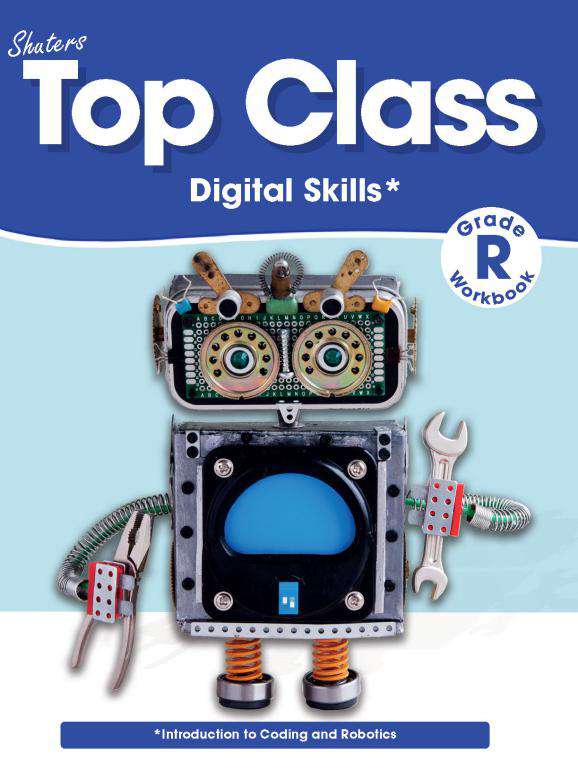
led to the Top Class Digital Skills Grade
R–3 workbooks and teacher guides.
Making quality Coding and
Robotics education achievable
The first challenge facing the roll-out of the curriculum
is related to accessing costly
technology, such as software and devices. This is perhaps the most
pertinent challenge. If not addressed, there’s a risk that the disparities
between well-resourced and under-resourced schools will continue to grow.
Additionally, schools may avoid implementing the curriculum for fear of the
cost implications.
One way of preventing this is to offer low-tech, cost-effective classroom solutions for Coding and
Robotics, such as those found in the Top Class Digital Skills series. One of the key principles
that underpin the series is accessibility. Kotzé’s vast experience in
facilitating coding clubs across a wide range of South African schools have
given him the insight needed to develop unique activities that can be used in
various contexts. Throughout the series, learners are encouraged to actively
participate in activities that require only readily available and affordable
objects, for example, crafting robots from cotton reels or cereal boxes.
Learners develop an understanding of the principles of computational thinking
and the engineering design process, without the burden of expensive devices and
software.
In South Africa, 70% of schools are low-fees or no-fees
schools. This low-tech approach helps schools cover the work set out in the
curriculum without excluding learners from low-income backgrounds. All learners
deserve to learn Coding and Robotics in a fun and relevant way and access to
resources, or a lack thereof, should not determine whether learners gain
essential digital skills. Quality Coding and Robotics education is achievable
by focusing on developing low-tech solutions.
The second challenge is teacher development. With numeracy and literacy competence at the
primary school-level being problematic, it’s no wonder that many stakeholders
are concerned about adding another subject to the teachers’ load. Most teachers
also have little to no prior experience with Coding and Robotics. For many,
teaching this subject is a daunting prospect.
The Department of Basic Education aims to overcome this
by providing country-wide Coding and
Robotics teacher training. However, this will be only the first step in
ensuring meaningful learning in the classroom. Support and the correct products
will be vital if teachers are to succeed at teaching new curriculum. Teachers
will require resources that provide
detailed, accurate, and simple-to-use explanations and answers. Shuter’s
thoughtfully developed the Top Class
Digital Skills series with this in mind. The teacher guides will be
especially helpful to teachers who have a limited knowledge of Coding and
Robotics.
Ensuring success for all
learners
As the world becomes more and more fused with technology,
the onus is on the education system to prepare learners to harness the
potential it offers. Coding and Robotics is not simply about learning to code
or building a robot. Instead, it provides the basic skills necessary to live
and work in a digitised world.
As Mark Surman, Executive Director of the Mozilla
Foundation, says: ‘Code has become the fourth literacy. Everyone needs to know
how our digital world works, not just engineers.’ The only way to guarantee
that all learners are ready for this future is by offering low-tech solutions
that can be used in every school in South Africa and providing teachers with
the support needed to teach effectively.